Built at a Community College: Lessons from the Student Experience
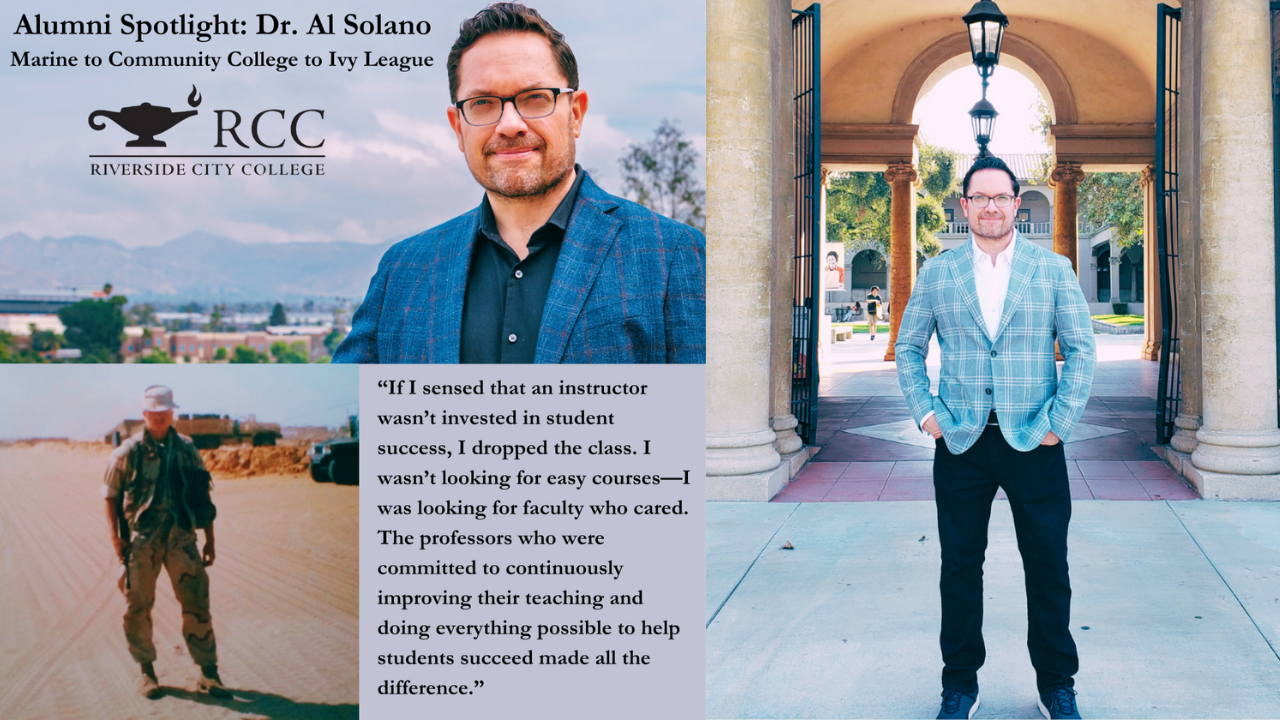
My community college alma mater, Riverside City College, published a feature titled “From Marine to Mentor: Dr. Al Solano’s Journey from RCC to Higher Education Leadership.”
Reading it was deeply personal. RCC was not just a college I attended. It was the foundation of my academic life. It was where I transitioned from Marine to student. It was where mentors saw something in me before I fully saw it in myself.
The article recounts my path from veteran reentry student to higher education leadership. What it really captures is something more important. It captures the power of community, mentorship, and intentional teaching.
Community Is Not a Slogan
One line quoted in the feature stands out to me now: “The most important word in ‘community college’ is community.”
As a veteran reentry student juggling responsibilities, I needed more than courses. I needed belonging. I needed guidance. I needed faculty and staff who took me seriously from day one. Financial aid staff, counselors, and the Veterans Center helped me navigate GI Bill benefits and academic planning at a time when those systems were far less streamlined
That support did more than help me enroll. It built confidence.
Community colleges are often described as access institutions. But access without intentional support is not enough. Community is what transforms access into opportunity.
Mentorship Changes Trajectories
The feature highlights two individuals who shaped my journey. Counselor Elizabeth Iglesias and history professor Dr. Ron Yoshino.
Dr. Yoshino’s simple affirmation that I was doing well in his class planted a seed. Later, he encouraged me to apply to institutions I initially believed were out of reach. His belief expanded my own.
Mentorship is not about grand speeches. It is about moments. A sentence. A suggestion. A recommendation letter. Educators often underestimate the weight of their words. They matter.
The confidence that grew at RCC ultimately prepared me for Cornell and later for doctoral work at UCLA while working full time.
That preparation was not accidental. It came from faculty who cared deeply about continuously improving their teaching and pushing students to grow.
Seek Faculty Who Care
One part of the feature that resonates strongly with my work today is this reflection:
I was not looking for easy classes. I was looking for instructors who cared and who were invested in student success. That mindset shaped how I approach institutional improvement now.
Students succeed when they encounter educators who are invested, intentional, and continuously learning.
Teaching excellence is not about charisma. It is about commitment. It is about refining assignments, clarifying expectations, and creating conditions where students feel both challenged and supported.
From Personal Story to Professional Mission
The feature outlines my journey from RCC to Cornell, then UCLA, and eventually into higher education leadership and the founding of the Continuous Learning Institute. What ties it all together is one realization:
Student success depends on educator growth.
I founded the Continuous Learning Institute because I saw that great ideas stall when institutions do not build systems that support faculty learning and follow through.
My own trajectory was shaped by educators who believed in continuous improvement. Now I help institutions design structures that make that mindset sustainable at scale.
Lessons for Educators and Leaders
Reflecting on this feature, several lessons stand out.
- Community Must Be Intentional
Belonging does not happen by accident. Institutions must design systems that welcome, guide, and affirm students.
- Mentorship Multiplies Potential
Encouragement backed by structure changes lives. Faculty and staff should never underestimate their influence.
- Preparation Matters
I often tell veterans to approach college like a deployment. Prepare, plan, execute with discipline. The same principle applies to institutions. Improvement requires preparation and follow through.
- Continuous Improvement Is Cultural
Students notice when faculty care. Faculty thrive when institutions invest in their growth. Culture shifts when that investment is consistent.
A Full Circle Moment
Serving RCC now as a partner through the Continuous Learning Institute carries special meaning. The institution that once supported me now invites me back to help strengthen its systems for faculty & staff learning and student success.
That is the power of community colleges. They are not stepping stones. They are foundations. When foundations are strong, trajectories change.
***