Reflections on the Columbia University Feature: Inquiry, Action, and What Actually Moves Outcomes
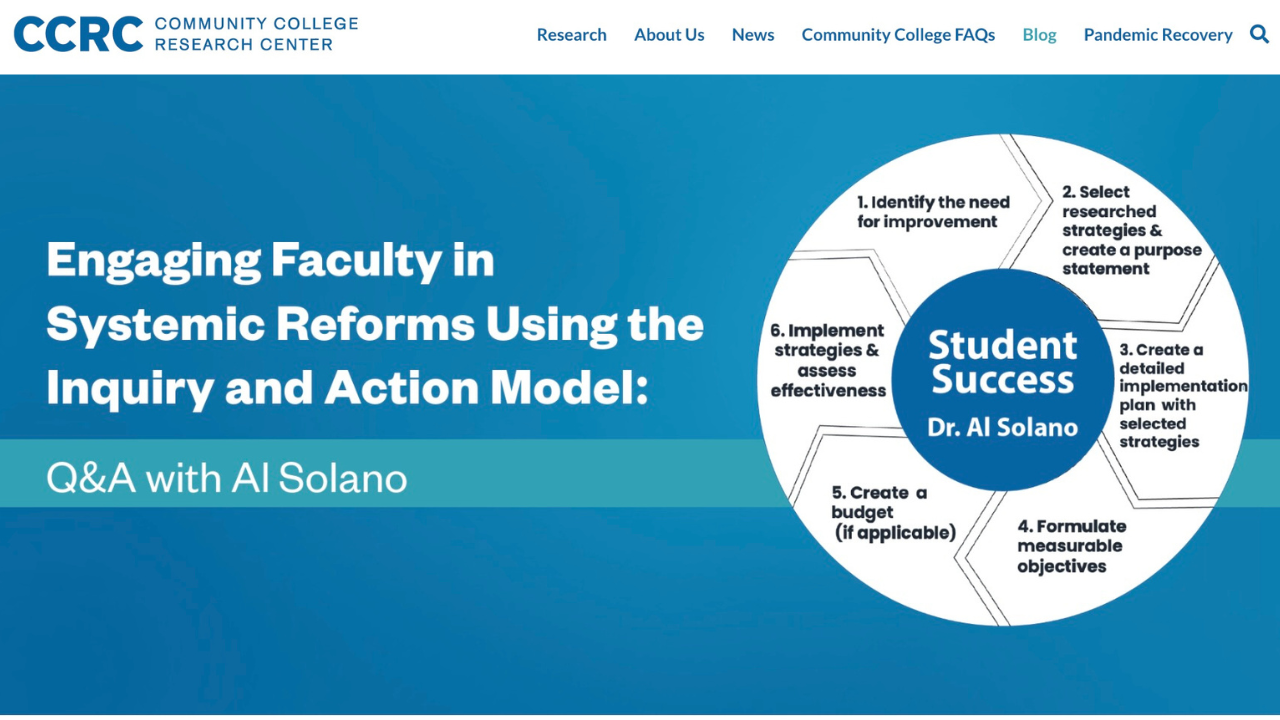
Columbia University’s Community College Research Center (CCRC) featured my work in a Q&A titled “Engaging Faculty in Systemic Reforms Using the Inquiry and Action Model.”
I’m grateful for the recognition, but more importantly, I’m grateful for what the feature represents.
It represents a shift in how we talk about reform.
Not reform as a document. Not reform as rhetoric. Not reform as compliance.
But reform as structured collaboration focused on measurable improvement.
The article highlights the Inquiry and Action six-step model, my structured approach to helping faculty and staff identify student challenges, analyze disaggregated data, design strategies, implement, and assess impact.
What matters most to me is not the model itself. It’s what happens when educators are given the right conditions to improve their craft together.
What the Feature Reinforced for Me
- Faculty Want to Improve. They Need Conditions.
One of the first questions in the interview addressed the challenges colleges face in engaging faculty in reform. My answer was simple: colleges often fail to create the conditions for meaningful collaboration
Faculty do not resist improvement per se. They resist fragmentation, performative work, and endless meetings without outcomes.
When teams are given:
- Dedicated time
- Clear structure
- Disaggregated data
- Skilled facilitation
- Administrative support
Improvement becomes energizing, not exhausting.
- Structure Creates Freedom
The six-step Inquiry and Action process mirrors the Plan-Do-Check-Act cycle but makes it operational for college teams. Structure is often misunderstood as rigidity.
In reality, structure:
- Prevents meetings from drifting
- Forces clarity
- Encourages equity intentionality
- Creates measurable objectives
When teams move through defined steps: identify the need, select strategies, create an implementation plan, set measurable objectives, implement, and assess, they experience momentum. And momentum builds morale.
- Improvement Is Cyclical, Not Instant
One of the most important parts of the feature was discussing outcomes.
Yes, I’ve seen dramatic results: enrollment increases of 500%, equity gap reductions of up to 20 percentage points, and nearly 100% retention in specific contexts. But I also emphasized something critical:
Not every team hits its goal in the first cycle. And that’s normal.
Inquiry and Action treats educators like scientists. You test a “treatment,” analyze results, refine, and try again. Continuous improvement is not linear. It’s disciplined iteration.
Colleges that embrace this mindset stop chasing quick wins and start building sustainable progress.
- Leadership Matters More Than Announcements
The feature highlighted something I’ve seen repeatedly: this work scales only when leadership provides:
- Modest funding
- Visibility
- Recognition
- Structural support
You cannot announce culture change into existence. You must resource it. When participation counts toward committee service or professional development, when team leads are funded, when time is protected, the work moves.
- The Real Outcome Is Cultural
The ultimate goal of Inquiry and Action is not just better numbers. It is fostering a culture of continuous improvement. Yes, outcomes matter. But something else happens that is equally powerful: Faculty morale improves.
Educators rediscover that they can work together to produce measurable gains for students. That sense of collective efficacy spreads.
One team becomes two.
Two become twelve.
Twelve become an institutional norm.
Final Reflection
Being featured by CCRC is meaningful because CCRC has long centered research on student success and systemic reform.
But what I care most about is this: The conversation is shifting.
Many campuses are moving from talking about reform to designing the conditions that make reform possible.
That is the work of the Continuous Learning Institute.
And that is the work I remain committed to: helping colleges move from strategy to coordinated, measurable action that improves student outcomes and strengthens educator morale.
Onward.