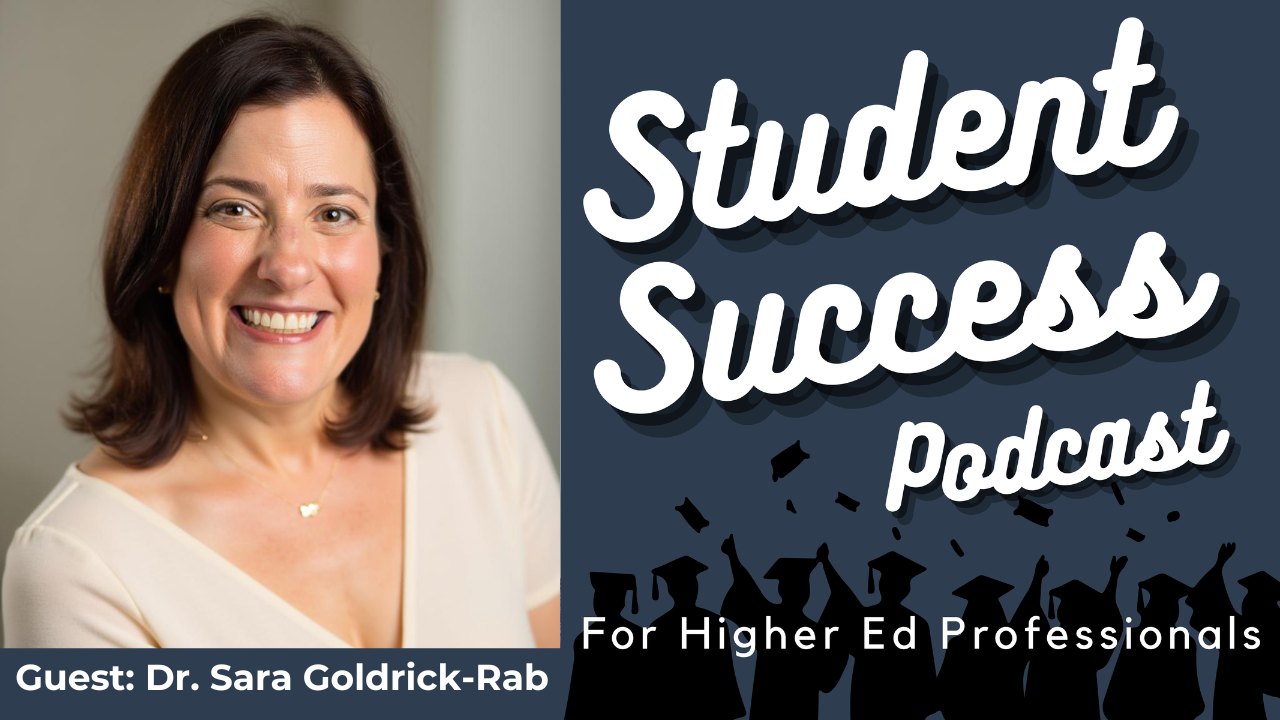
Student Success & Equity with Dr. Sara Goldrick-Rab
LISTEN TO THE EPISODE:
Learn why college student success begins with meeting students' basic needs.
Apple | Spotify | YouTube | Substack
Dr. Sara Goldrick-Rab unpacks her book, Paying the Price: College Costs, Financial Aid, and the Betrayal of the American Dream (2016). Ten years later, her book is as relevant as it was in 2016, if not more. She connects college affordability to basic needs, humane campus practice, and that small financial shortfalls can derail completion.
First of all, connect with Dr. Sara Goldrick-Rab on LinkedIn and check out her website to learn ways she can support you and your institution. During the interview, she discussed the Believe in Students #RealCollege curriculum master class resource, public speaking engagements to energize your campus, and special “office hours” to support college educators as they continue to strengthen their institution’s ability to serve better students.
Key points:
• The origin story and research design behind Paying the Price
• That money shapes learning, health, relationships, and time in college
• How financial aid often gives students some support but not enough
• Food insecurity, housing insecurity, and the #RealCollege reality
• What created momentum for the #RealCollege Survey and basic needs work
• Practical examples from campuses of what worked and what didn't
• Lessons from the pandemic and why the current climate feels worse
• What higher ed must stop pretending about affordability and funding
• Resources Dr. Goldrick-Rab points people to now, including the Believe In Students #RealCollege Curriculum Masterclass, speaking engagements, and office hours for educators
Key quote:
"College students are going through the same things that regular Americans endure every day. And that is to say that college really is about real life. I coined the phrase #RealCollege shortly after putting my book out because I was tired of people pretending that college was this magical moment where you were somehow just put in a bubble and given this glorious little experience that just separated you from everybody else.
If regular people are having trouble with dealing with inflation, then college students are having trouble dealing with inflation. If regular people are having trouble with rent, college students are having trouble with rent. If regular people are having trouble juggling not enough time in their day between childcare and transportation and their actual work and school, then that's what's happening in college too. And so it really drove home the point that college students are complicated adults with lives, just like everyone else."
About Dr. Sara Goldrick-Rab
Sara Goldrick-Rab is a sociologist and lifelong poverty fighter whose career spans groundbreaking research on economic security, university and community college teaching, and the leadership of national research and policy organizations. As a scholar and author, she transformed national conversations about college affordability and basic needs, and built the evidence that moved governments at every level to act — championing community college funding and support for people facing hunger, housing instability, and financial hardship. A Philadelphia-based researcher and policy strategist, she now partners with governments, colleges, and nonprofits to turn rigorous research into practical action, with current work spanning workforce development, public benefits access, and economic mobility.
About Dr. Al Solano
Dr. Al Solano is the Founder and Coach of the Continuous Learning Institute, where he partners with colleges and universities to strengthen student success and equity through sustainable, campus-driven practices. A strong believer in the power of kindness, Al coaches higher education teams using his signature framework—the “Three Cs”: Clarity, Coherence, and Consensus.
With decades of coaching experience, Al has worked directly with more than 50 institutions and trained thousands of educators nationwide. His widely used, practitioner-focused articles on student success strategies, institutional planning and implementation, and educational leadership are embraced by campuses across the country.
Al began his career in K–12 education, later serving in roles at two community colleges. A proud community college transfer student, he earned his bachelor’s degree from Cornell University and a doctorate in education from UCLA.
Transcript
AL: 00:02
Welcome to the Student Success Podcast. If you work in higher ed and want to learn ways to support students, check out today's episode. Welcome to the Student Success Podcast, Dr. Sara Sara Goldrick-Rab
SARA: 00:20
Thanks so much for having me.
AL: 00:22
So tell us a little bit about yourself.
SARA: 00:26
Well, first of all, I am talking to you from Philadelphia today, where I live with my family. Got two teenagers, one in college, one going there soon. I have been in and out of academia for almost 25 years now. I'm a sociologist by training. And I'm extremely interested in what makes it possible or difficult for people to succeed in getting through college, which we're told is the way to achieve the American dream.
AL: 00:55
Yes, and this September will be 10 years since you wrote your book, Paying the Price. And you got to go on Trevor Noah, you got like this national movement because of that. You created such an awareness. Because it's been 10 years. Can you take us back about your why? Tell us more about the book, remind us and about your findings.
SARA: 01:23
Sure. Well, um, Paying the Price, college costs, financial aid, and the betrayal of the American dream is the story of what happened when a set of wealthy philanthropists set out to do what so many people really wish they could do for folks, which is to create a massive scholarship program to make it possible for more people to afford college. I was a professor at the University of Wisconsin-Madison at the time when these wealthy individuals set up this new fund. And they really wanted to know not only, you know, would people appreciate the money, which you can imagine that they did, but they really wanted to know if the money would move the needle, so to speak, particularly when it came to college completion. And I was honored to be involved in helping them to kind of strategize and design the program, and then I led the evaluation for it. And so that evaluation began in 2008, which, if you recall, was a very difficult economy. It was the point at which sort of the bottom fell out of the housing market. And so students really needed financial support for college. They'd always needed it, but they really needed it at that time. And I began the process with a big research team of kind of following a group of people, all of whom were receiving the federal Pell Grant, and they were going to college across the state of Wisconsin, all 42 public two-year and four-year institutions. So this is about community and technical colleges and about universities. And we followed them, we tracked their progress initially for six years, which I describe in the book, but then actually we ended up doing a subsequent follow-up study up to about 10 years. And what the book is about is about everything that we learned from really getting to learn from these students. Um, and there are several things that happened in that course of that. One thing is that we didn't just talk to students one time or learn from students one time. We decided that their experiences with college and with financial aid and with paying for college would evolve over time. And so, knowing that that was already the case, we surveyed them multiple times across their lives. And we also interviewed a cohort of 50 of them over and over and over. So, you know, um, on Trevor Noah, he said, you know, I understand you followed these students around. And I said, yes, in a non-creepy IRB -approved manner. I had the opportunity to do what, you know, many people who work in colleges don't get to do, which is to learn from people whether or not they stay in your institution. I used to sit down with people, I sat down with some of these students who had left their community college and were sitting with me at a fast food joint in a rural Wisconsin town to talk about what happened. So that was another component. And then the last part was that we actually had a randomized control trial going on because those wealthy individuals, while they were very generous, the money that they gave, it wasn't enough to give it to everybody. So of those uh eight of those 3,000 Pell Grant recipients, 1,800 of them were not getting the additional scholarships, and 1,200 of them were getting the additional scholarships. And they weren't chosen because these were like the perfect people to give it to, or these were better people. It was a coin flip. So we were able to directly compare what happens when you get more money and what happens when you don't. So the book is what we call in research a mixed method study. So we're drawing on quantitative and qualitative data to ask, okay, so you know, what were the bottom lines? And the first and foremost bottom line, I'm sure you're gonna be totally shocked by this, Al, um, is that money really matters in college. It matters, it it shapes. Um, I I you know, I often quote the Wu-Tang clan, you know, cash rules everything around me. We can't say enough about how much it's impossible to separate what students are doing, thinking, and learning in college from their ability to pay for that experience. And the book really shows that. It doesn't just show whether students could pay for their textbooks or whether students had a nice laptop or even just the number of classes they were able to take. It shows the effects on their mental well-being, on their physical health, on their relationships with their families, on the friends that they had and their social experiences. And it shows it not just as a one-time thing, but as an evolving process. The second thing, and this was a very big deal, was that we really illustrated that while financial aid is needed, what we're giving, and even with the private scholarship, was not nearly sufficient. So it was leaving students with some money so that they believed they could be there, but not enough money to actually have their needs met. And so this was the book that for the very first time had an entire chapter about students going to school with some of what they needed and not all of it, and falling short on, for example, the money for food and demonstrating that, you know, there is this incredible uh inefficiency to this process where we've invested billions of dollars in student loans and student grants and so on, but still left students with just enough short that they don't have any food in their bellies when they're trying to actually learn, which in turn leads them to drop out of college over things like a $200 shortfall. Okay, so that was the second piece. And the third part was really kind of illustrating the extent to which today's college students are going through the same things that regular Americans endure every day. And that is to say that college really is about real life. I coined the phrase #RealCollege shortly after putting this book out because I was tired of people pretending that college was this magical moment where you were somehow just put in a bubble and given this glorious little experience that just separated you from everybody else. Look, if regular people are having trouble with dealing with inflation, then college students are having trouble dealing with inflation. If regular people are having trouble with rent, college students are having trouble with rent. If regular people are having trouble juggling not enough time in their day between childcare and transportation and their actual work and school, then that's what's happening in college too. And so it really drove home the point that college students are, you know, complicated adults with lives, just like everyone else. And so those are the three big things. Money matters a ton. The financial aid system is not doing what it really needs to do in terms of delivering the money, both in terms of not giving enough and not doing it in a humane way. And three, that college students are humans like everybody else and need to be treated as such.
AL: 08:32
Well, thank you so much for that overview. And I know it was a long time ago. Actually, not that long ago when you think about it, but you know, uh, just thank you for doing that study. It's so well done. And you sparked the movement. Like you said, real college. I saw everyone from institutional researchers to faculty to college presidents have the hashtag Real College (#RealCollege). To this day, I see it on their profiles.
So when you wrote the book and you were creating this awareness at the time and up until now, what was giving you hope in terms of what you saw colleges really doing, really addressing what was that hope that you saw and what they were doing while at the same time, where were still some things where you're like, oh my gosh, they still have such a long way to go. Uh yeah, your thoughts on that?
SARA: 09:26
Yeah. Well, let me first say that at the time that I published the book, I had created an organization that was called the Wisconsin Hope Lab. And I was using the word hope for um two things. One was it was an acronym. It stood for harvesting opportunities for post-secondary education. And I said that because we were coming from a time where the focus on opportunity was still really important. And I have to say it still is. I know we have shifted the discussion from access to completion, but we should not shift away from the focus on access because we cannot pretend like there aren't people still completely gated out of higher education. People in rural communities, even some in urban areas who are being left out of the systems that are bringing people into higher education, um, that still remains an issue. But the other reason I use the term hope is because hope is a strategy. There is a science of hope. We are doing this interview on International Hope Day. There's an entire set of organizations that are promoting the science of hope and encouraging people to use it. And so what I was really saying was yes, higher education is facing a lot of very difficult challenges, but we are not going to improve if we look at the whole thing and say there is no hope. We had to believe that we could do the hard work and engage in an optimistic manner, not a naive manner, but an optimistic manner to create better. And that is in fact what was giving me hope, which was that I was getting to know, starting very early in my career, I was getting to see colleges and students working under very different uh difficult conditions. And yet they kept at it. So at the very beginning of my career, that was the time when thanks to Bill Clinton, you know, a Democrat, we saw massive changes to cash assistance to families with low-income children, right? And you know, uh what was called um a welfare, welfare reform. And we had seen community colleges have to give up programs for low-income moms in college. That was terrible. I was studying what happened when that system and the workforce development system transformed into something that colleges and especially community colleges had never recognized. But I still didn't hear college leaders say we need to stop doing this work. I heard them say we're gonna find another way. And similarly, when I started to put evidence out there that said, you know, I know the community colleges are trying, but I can also tell you you've missed something. You're talking about how we need to push people to go full time or how we need to accelerate their pace in college without talking about the real reasons they're not going faster. I heard them begin to say, oh, that's interesting. Now, I want to be honest. When I first started doing work around measuring food insecurity and housing insecurity and higher education, and I said to the nation's community colleges in partnership with the Association of Community College Trustees, hey y'all, let's do this survey. Only 10 community colleges in seven states said yes.
AL: 12:32
Oh, wow.
SARA: 12:33
Ten. Ten. I mean, that's abysmal. Like I was horrified. How can only 10? There was more people in my inbox saying we're interested, but then they wouldn't actually do it. So to be honest with you, that was very disheartening. And then when I did the survey and we learned what I wrote about in the New York Times the next year, um were these dismal results, you know, that that like 50% of community college students were dealing with food insecurity and housing insecurity. And, you know, uh one in 10 was dealing with homelessness. The only part that gave me hope was that we went very quickly from 10 colleges to 70 colleges, and from 70 colleges to 123 colleges, and from 123 colleges to 300 colleges. And to date, more than 800 colleges in the United States in all 50 states and the District of Columbia have done the #RealCollege survey. And we're at the part now where I don't think we need colleges to do that survey. What we need colleges to do is work on their response to this challenge.
AL: 13:38
Right.
SARA: 13:39
So I have found immense hope, right, in the willingness of the sector's leaders to embrace what they did not know and to consider there might be another area for them to focus their talents on.
AL: 13:54
So what specific activities or implementation that you start to see after everybody is going, I get it. All right, the survey is wow. Okay. It's very sobering. And in the field, what were you learning about what some colleges were doing where you felt where that hope, right, uh was just enhanced. It was energized even more. What were some nuts and bolts things that you saw?
SARA: 14:22
Well, at the very beginning, when we had these data, we wrote about it in the New York Times. And that's not a small thing. I want to say the response that you were seeing around hashtag RealCollege and all of that, that was concerted cultivation, right? We engaged in a proactive campaign to translate research evidence into change that involved media work. And when we wrote about it in the New York Times, I was hoping the response would be funders coming and saying, let's do more science. And that wasn't what happened. What happened was my inbox filling with people working at colleges who said, Oh my goodness, somebody else is seeing this too. So I immediately found hope in the fact that I learned about the existence of people, especially in California, writing to me from across California community colleges and some of the universities, some of the nonprofits saying, We're working on this. I met a guy named Lewis right off the bat who said, I found out that there were homeless college students at UCLA, and I gave up the money my parents were giving me. I gave it to these homeless college students, and I lived in my car until I could start a nonprofit shelter for these homeless college students. I mean, I was like, wow, that's amazing, right? Then I learned, for example, about an intervention, a program called Single Stop that ACCT was getting interested in that was out of New York. And I became the first evaluator of that program to understand how it was trying to work with students to be um to connect them to public benefits so that they could eat in college. Right. And then I learned about the College and University Food Bank Alliance that was beginning to grow, that had just a handful of institutions and grew bigger over time. And then I met Michael Sorrell at Paul Quinn College, and I learned about the way in which he closed down a football stadium and built a garden because students needed to eat more than they needed to go to football games. Right? And these people really became part of what was giving me energy. We didn't know yet which of these things would work well. Right. And to be clear, some of those things don't work as well as others. I am not a fan of the food pantry movement anymore because it is not a very effective thing. However, what it signals, which is an interest in doing the work, that is a positive. And then life started to get really good, I have to say, when I met two people in particular. Um, the first is Russell Lowry Hart, who was at Amarillo College at the time, and he found me on Twitter. You know, I used to be very active on Twitter. Twitter has created some of the best and worst moments in my life. And the best moments were when Russell Lowry Hart responded to my tweets about these issues with we're doing this work at Amarillo College, and told me about what he was doing. And I thought either this guy is gonna make my day or he is full of it. And I reached out to the Trellis Foundation in Texas and said, Would you give me a little bit of money to get on a plane and go down there and do a little investigative, you know, evaluative work to see what I really think of his model? And the truth is it was real. And Russell has become one of the most shining beacons of hope of this work, and he's doing it in a red state, and that matters. And the other person who reached out to me through colleagues and convinced me to come visit his campus is Keith Curry and Compton College. And I'm happy to say now that Keith is basically like my brother. Um, you know, we're about the same age, we grew up on two different parts of the world, two different types of families, and so on. And yet we have very similar thinking about what bold, unapologetic leadership looks like when you're really centering students. And every day or every week, Keith calls me and says, I'm gonna do this thing. And I'm like, You are, you are the product of my wildest dreams. I'm serious, you know. Like, like it's amazing the things he thinks about doing and the way in which during the pandemic, he didn't just, you know, open another food pantry. He he made sure that meals were delivered to students' houses directly. You know, he fought for policy change and he secured money so that they could actually build housing for affordable housing for students on the college campus. You know, he just keeps pushing further and further. And so that really keeps me going.
AL: 18:54
Well, thank you for sharing those stories. So I'm sighing, right? Here we are. We're seeing so much funding being dismantled.
SARA: 19:09
Yeah.
AL: 19:10
Um, we're seeing, um, I think the best word I can use is just cruelty. Uh so how are you seeing colleges adapt to this environment? What are you learning about this in environment and where where do you think the aftermath of this might look like, right? Like I'll give you one of my views on this. I think that something that tries to keep me sane, the light at the end of the tunnel, is that after um this cruel movement is no longer have the kind of power that it has now, I think that movement has always been with us, it's just had different names, right? And given all the dismantling, I think we have an opportunity to come back and not rebuild, but rebuild differently. Um, right? You know me a little bit. I'm all about continuous improvement and I'm kind of a truth teller when even good things are happening when we have uh organizations that are doing certain things, I'm always like, well, wait a second, that could be improved a little bit more, right? So to me, I'm hoping that when this nightmare is um gosh, I hope it's gonna be gone, right? That we are able to build better. Anyway, that's my take on it. But what are you seeing out in the field? And what's your take on all of this?
SARA: 20:42
Yeah. Well, I mean, first I want to be very real that, you know, we've been through a couple of different things in this past decade since I wrote this book. And the first was the pandemic. And uh, you know, that was brutal. I mean, I've even just I can see personally what that even just did. I I was working so hard with my team at the Hope Center for College Community and Justice to support colleges. I can see the physical results of the pandemic and myself in pictures, right? Just just the effort that everybody had to get together to put in to just try to make sure that people were okay and the the level of crisis response. And yet, even after it's over, we were able to see some silver linings to it. Not we're not glad it happened. And it's terrible how many people died unnecessarily and how badly managed the whole thing was.
AL: 21:32
Badly managed.
SARA: 21:33
Right? We did see um some adaptations of basic needs work became much more central. Um, I'm not happy about the way in which some folks seem to have forgotten how important it is to sustain that work. That isn't only pandemic era work. But nonetheless, you know, basic needs practitioners were funded at higher rates and placed onto campuses, and benefits access was expanded, and we learned from science of that. You know, some of the best evidence that we have that public benefits can support college students and do good work comes from things like the child tax credit and the SNAP expansions that happened during the pandemic. This moment is not that moment. I have to say, this moment is magnitudes worse. Um, many, many magnitudes worse. And I think when we say, you know, this moment, this isn't about one particular movement. I don't think MAGA can take credit for this, to be honest with you. This is pure hatred, racism, and misogyny all coupled together. And as you noted, it's been there. I mean, you know, the same people who are who are saying and doing these things, whether it's in our sector or whether it's in health and human services or whether it's in the law, these are the same people who, if they'd been given a choice, wouldn't have ended slavery. I think we have to be real clear about that. They look at progress that we consider progress, and they say, there goes the neighborhood.
AL: 23:02
Right.
SARA: 23:02
They are the people talking about putting, you know, a closed sign on the Statue of Liberty.
AL: 23:08
Hm, hm.
SARA: 23:09
So let's be clear about that. What I hope we get out of this is a sense that we can never sit back and rest on our laurels. That that fight is always and ongoing. And I frankly hope we take, and I'm trying very hard to take lessons from African Americans who have been through the worst that this country can possibly offer anybody, and still found ways to love the country. Like still found ways to get up in the morning. I am gobsmacked at the resilience, the stamina, the way in which you know, a group of people has been just put through hell and nonetheless manages to find days when they celebrate and have joy and and engage in their community. And I think that in some of the ways that they do that is by getting very small and local. I spent some time recently working very, very locally. Like, can I just help a small group of children for a period of time and make a difference? Because I can't make the difference for them in federal policy right now. And I have to say, yeah, it's really rewarding and it reminds you that these are human stakes. But I hope that the sector looks at itself and says, we can no longer walk around and say stupid things like college is getting more affordable when everybody who knows anything knows that's not true. That we can no longer operate institutions that aren't ready to take care of the people. We have no business taking people's money if we're not ready to take care of people. And that we have no business operating as if there's just going to be continuous money coming in. That we've got to start to plan much more carefully about where our dollars go, making sure that we don't waste money. And we waste money in higher ed every day. The number one way we waste money is that we allocate the most money to the education of students who need the least support. I would like to see the end of scholarship aid to people who don't need it. I would like to see changes in state appropriations away from flagship institutions towards community colleges and it completely cut off any institution that's that, you know, if you accept less than 20% of applicants, you shouldn't be getting public funds. Just stop. Just, you know, you're not fulfilling the public good, you know, unless you're a historically black institution or a tribal college, and most of them are accepting the majority anyway. So, you know, I hope that we take those things from this, and I hope that we're not naive anymore, because in some ways we are in trouble right now, because we have been naive. Kind of deliberately naive for people who consider themselves to be a research-based, scientifically based sector.
AL: 26:02
You know, we can talk, we can do maybe a seven-part series on this. I have so much to say about all that.
But you know what I want to do though, because you've been such a tremendous resource for the country, for higher ed, for education in general. Um, so what are you up to these days? What what kind of resources are you working on? Um, tell us more because I I'd love people to tap more into your good work and because you're a fighter and you're gonna bring a perspective of truth, of reality. And um, you know, we need that, and at the same time balancing it with care and kindness. So what are you up to?
SARA: 26:52
I'm finding my way like everybody else. You know, I want to be clear to people that, you know, having had the career that I had did not protect me from being 'doged.' Um, it didn't, you know, I wasn't sitting there with a tenured professorship at the time that all of this started to happen. I left the academy as many years ago now. Um, you know, I was working as a consultant and like so many consultants and so many researchers and so many in higher education, I saw the end of a bunch of funding streams. Um, you know, but you're right, I'm certainly persistent and I walk around every day with this tattoo on my arm that literally says Pell, right? Because this was my cat Pell. So um, you know, it's not like I can turn away from higher ed. So I'm doing a couple of different things right now, trying to find ways to make the biggest impact that I can while also being kind to myself and my family as we navigate this, you know, this economy, which is which is cruel. Um, we're certainly on, you know, recognize that we are not nearly as bad off as many others, but we are impacted. I, you know, we're in the great majority of people in this country who are certainly impacted by this lousy political and um economic situation. So I'll tell you about uh three things in particular. Um, one, the nonprofit that I founded when my book came out, um, which I used the book awards and some of the speaking money and some of the proceeds from the book uh to create. It's called Believe in Students, which shouldn't surprise you given the book's findings. Um, Believe in Students is 10 years old this year. It is a national nonprofit with independent leadership. I'm not on the board. I am no longer an employee there. It's run by a woman named Traci Kirtley, who's absolutely fantastic. And Believe in Students has a set of tools, one of which I co-created with Jesse Stommel, called the #RealCollege Curriculum. And the #RealCollege Curriculum is professional development for faculty and staff, uh, could be in any sector of higher education, and it is there as a tool to help people learn how to engage students in a humane way, to treat students as humans first and be effective in working with them. And so one thing that is available is it's a very low-cost, easily scaled solution on the professional development side of things. It's a master class for higher education. And so I'm supporting the implementation of that work at Believe in Students. Uh another thing that I'm doing is I'm getting ready to get back on the road a little bit around the 10th anniversary of paying the price and do some public speaking, some rabble rousing, um, some support of those who are trying to fight back around the country. Sort of a book tour of sorts, doing it virtually, also doing it a bit on the road. I'll be going out to Washington State and so on. And so if folks are looking for a speaker, you know, who's willing to say what needs to be said, who can uh hopefully capture an audience and support their efforts to educate, raise funds, and so on in their community, people can reach out to me about that. I still do have some flexibility in this fall and the coming spring timeline. Um, and then the other thing I'm doing right now, which I just announced on LinkedIn, where I am, I'm not really on Twitter these days. Uh, I really have focused my attention on LinkedIn primarily, um, is I'm holding summer office hours. I really figured that there have been a number of people who've reached out, you know, have said, like, will you take me on as a graduate advisor? Well, I don't work for a university anymore, so no, I can't be your grad advisor, right? Or a practitioner who needs some help or some time. So I decided to open up some sliding scale fee office hours so that I can do some just, you know, one-off support of folks. So a dean booked me this morning to talk about some planning for some work that he's doing. For example, a nonprofit booked me to help with some strategic planning work that they're doing. This doesn't have to be a major engagement where we have to go through ages and ages of contracting. Um, this can just be, you know, some thought partnership or some specific uh research advising. I have, you know, I've raised $25 million in research funds in the past. I've designed countless studies. I'm here to help people from all sorts of backgrounds to be able to make some progress if they can. And beyond that, frankly, I'm looking. I'm not entirely sure what's next for me. I'm approaching the you know the midpoint. I'm considering the midpoint of my life, turning 50 next year. Um my grandfather's about to turn 100, so I have every reason to believe I'm not even halfway done. Um so uh I'm trying to figure out you know what is the best way in the next stage of my work uh to support this this effort of of helping both higher education and its communities do better.
AL: 31:49
Yeah, you have at least 50 summers left. Okay. I hope so. Yes. I really do. I am so grateful that you came on the Student Success podcast because um just about every college that I work with, they are familiar with your work, right? Uh they're familiar with the book, but I think it's been a while. And I want to just to remind everybody about that book. I want to remind everybody that you're still here, that you're still advocating, that you're still doing great work. And also, you know, I think our education community, it's important. I've seen this happen since this administration took over, is kind of taking care of each other, having each other's backs. As you said, a lot of researchers lost a ton of funding. We just saw the dismantling of this higher ed economy, right? And so there's a lot of people out there that are still so relevant, that can still do meaningful work. And I just want to you know put a spotlight on those people like you. So the I believe curriculum, the book, right? Um the office hours that I'm sure you can extend probably beyond summer and all the things that you mentioned, uh I assume you can get me is it through your website? Because I'm gonna have this on the show notes.
SARA: 33:09
Absolutely. I really recommend folks find me on LinkedIn if they haven't already, because I'd love to connect with more people there and and there's information there. And then, yes, on my website um also you can easily get in touch. And I'm uh I'm folks, I don't bite. I really do enjoy talking to all kinds of people, and I'm most intrigued by people who disagree with me. So I would also really love to hear from those who um have a different perspective. Um, you know, I I do miss in some ways living in Wisconsin where I heard different perspectives almost every day. You know, now I live in this very blue city. Um, so I appreciate all kinds of outreach. And um, Al, I really appreciate you. We've had some of the most fun conversations I've had this year. So you teach me all the time.
AL: 33:52
Oh, my pleasure. It's uh in fact, that's how we connect it was through LinkedIn, right? Twitter among the many things that
SARA: 34:01
Well, I'm one of your readers. So thank you.
AL: 34:04
Thank you. You're one of the one or three. Thank you. One of the three. I appreciate that. Um, yeah, because that the guy who did Doge and got rid of USAID and so many, he also destroyed Twitter, right? So it seems like most educators migrated over to LinkedIn, which for the most part, people behave a lot better there than you know, Twitter and other places. So uh yes, so please uh look for Sara on LinkedIn. I'm gonna have in the show notes the links to her resources and to get in touch with her. Uh, thank you so much for all that you have done for students. And um, you know, just keep on fighting and keep on having that hope.
SARA: 34:44
Thank you.
AL: 34:46
Thank you for participating in the student success podcast.
AL: 34:50
Thank you for listening to the student success podcast. You can subscribe to the show and newsletter on the Continuous Learning Institute link below, and of course on Apple Podcasts, Spotify, YouTube, or wherever you get your podcasts.